Showing posts with label Audi. Show all posts

Audi Q7


The Audi Q7 is the large Audi for the sporty individualist - the high-performance SUV for sport, leisure, family and business. Now Audi has made it even more powerful and efficient, with a choice of three new V6 engines and an 8-speed tiptronic transmission.

Even more power, even higher efficiency: Audi has revised the engine lineup for the Q7. The two gasoline engines, both V6 units but with different power outputs, are new, and so is the second-generation V6 TDI. A mighty V8 diesel completes the range. All the engines for the Audi Q7 combine two technologies: forced induction and direct fuel injection. A high-performance recuperation system that recovers energy during braking is also a standard item with all six- and eight-cylinder engines.

The new 3.0 TFSI gasoline engine embodies Audi's downsizing strategy: replacing engine displacement with supercharging. Within the 90-degree angle formed by its cylinder blocks there is an engine-driven supercharger that compresses the intake air. Two charge-air intercoolers prevent the air temperature from rising, so that the engine draws in more oxygen for the combustion process. Vigorous thrust and spontaneous throttle response make the 3.0 TFSI engine, with its sonorous note, an ideal source of power for the large high-performance SUV from Audi.

Two versions of the supercharged V6 are available. The basic version develops 200 kW (272 hp) and has a maximum torque of 400 Nm (295.02 lb-ft) over a broad engine-speed range from 2,250 to 4,750 rpm. It accelerates the Audi Q7 in 7.9 seconds from a standing start to 100 km/h (62.14 mph) and gives it a top speed of 222 km/h (137.94 mph), or 225 km/h (139.81 mph) with adaptive air suspension.

The more powerful version of the 3.0 TFSI delivers 245 kW (333 hp) and a torque of 440 Nm (324.53 lb-ft) between 2,900 and 5,300 rpm. 100 km/h (62.14 mph) are reached in 6.9 seconds, with powerful forward progress continuing until 243 km/h (150.99 mph) are reached; with adaptive air suspension the top speed is 245 km/h (152.24 mph). Both versions of the 3.0 TFSI are impressively efficient: in the EU fuel consumption test cycle they are content with 10.7 liters per 100 kilometers (21.98 US mpg). Compared with the previous engines, the 3.6 FSI and the 4.2 FSI, fuel consumption has been reduced by 1.4 and 2.0 l/100 km - 12 and 16 percent respectively. Read More!

Audi Q3


Audi is venturing into a new market segment: The Audi Q3 is a premium SUV in a compact-class form. It is sporty, efficient and versatile - a vehicle that is equally comfortable on or off the road. Every aspect of the Q3 showcases Audi technology - the body, the drivetrain, the chassis and the assistance and multimedia systems. Many of its solutions are straight from the luxury class.

The Audi Q3 is immediately recognizable as the youngest member of the large Audi family. The coupe-like lines are an expression of its sporty character. Sharp edges frame elegantly arched sheet metal surfaces, and distinctive lights accentuate the front and rear. The wedge-shaped headlights are optionally available with xenon plus units and LED daytime running lights, which Audi also combines with LED tail lights.

The low roof line, which begins dropping rather early, and the very flat D-pillars underscore the dynamics of the Audi Q3. Add-on parts are available in a number of variants - customers can choose between black, anthracite or the body color. There is also a choice of two exterior packages.

The base version of the Audi Q3, which will be available somewhat later, weighs 1,445 kilograms (3,186 lb). Its rigid, safe and quiet occupant cell integrates a number of ultra-high-strength steels. Both the engine hood and the tailgate are made of aluminum. As is typical of the Q models from Audi, the undivided tail lights are integrated into the tailgate, which wraps around the pillars. At just 0.32, the coefficient of drag is unusually low. The compact SUV is 4.39 meters (14.40 ft) long, 1.83 meters (6.00 ft) wide and 1.59 meters (5.22 ft) high.

The Audi Q3 offers ample room for all five passengers and sets new standards for ergonomics and workmanship. A wide variety of materials and colors for the interior offers customers countless possibilities for expressing their own personal style. The wrap-around, a large arc extending from one front door to the other, is a design feature borrowed from the large Audi model series.

The luggage compartment of the compact SUV has a capacity of 460 liters (16.24 cu ft), which can be increased to 1,365 liters (48.20 cu ft) by folding down the split rear seat backs. A roof rail is standard. Many useful options, including a luggage compartment package and a pass-through hatch, make the Q3 even more versatile and convenient in everyday use. Read More!

Audi S5


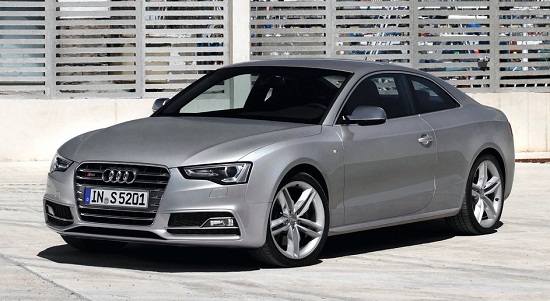
Audi is refreshing the A5 model series. Advanced technologies are being added to the Sportback, Coupé, Cabriolet and S5 models in the areas of the engine, quattro drive and infotainment for even more efficiency, sportiness and intelligence. The updated design visually underscores the technical expertise involved in these versions.

The Audi A5 models are now more distinctive than ever. The rear lights and the headlights have been redesigned and are optionally available in xenon plus technology with homogenous LED daytime running lights. New colors and materials accentuate the interior, and many details of the operating concept have been fine-tuned.

Each of the four TDI diesel and three TFSI gasoline units in the new engine lineup include forced induction and direct fuel injection. The new 1.8 TFSI features a number of groundbreaking innovations. Fuel consumption has been reduced by 11 percent on average. The start-stop system and the recuperation system come standard with all engine-transmission configurations.

Each engine is matched with the ideal drivetrain - six-speed manual, multitronic, seven-speed S tronic, front-wheel drive or quattro drive. When combined with S tronic, the quattro drivetrain uses the crown-gear center differential and torque vectoring; the sport differential is the perfect complement. The chassis has been more finely tuned, with the optional Audi drive select system and dynamic steering making the Audi A5 even more fun to drive. The electromechanical power steering is new to the Audi A5 family.

The new A5 is a highly intelligent car. Its driver assistance systems have undergone intensive further development. The range of infotainment options now includes the Bluetooth online car phone, which delivers a number of special services and connects the Audi A5 to the Internet. Read More!

Audi S6


The Audi S6 and S6 Avant use the 309 kW (420 hp) version of the new 4.0 TFSI. The twin-turbo V8 provides a constant 550 Nm (405.66 lb-ft) of torque from 1,400 to 5,300 rpm. It accelerates the S6 from 0 to 100 km/h (62.14 mph) in 4.8 seconds and the S6 Avant in 4.9 seconds. With both models, the electronically governed top speed of 250 km/h (155.34 mph) is just a formality.

The 4.0 TFSI brings Audi's downsizing strategy to the high-performance class. Compared to the engine in the previous model, the free-breathing, 5.2-liter V10, it offers even sportier performance while reducing fuel consumption by as much as 25 percent. Average fuel consumption is just 9.7 liters per 100 km (24.25 US mpg) in the Audi S6 and 9.8 liters (24.0 US mpg) in the Audi S6 Avant, well below that of the competition.

A number of technologies contribute to this top result, including the recuperation and start-stop systems as well as the new "cylinder on demand" cylinder management system. When the V8 deactivates four cylinders under part load, the Active Noise Cancellation system (ANC) is activated. Four microphones integrated into the headlining record the noise in the cabin, which is then analyzed by a computer. If the computer detects intrusive sound elements, it broadcasts an antiphase sound through the speakers of the sound system. This sound combines with the intrusive sound and largely cancels it out.

Independent of this, active, electronically controlled engine bearings use targeted counterpulses to attenuate low-frequency vibrations. A sound actuator, flaps in the exhaust system, the engine shroud and a newly developed two-mass flywheel with a centrifugal force pendulum in the seven-speed S tronic also contribute to the sonorous sound and smoothness of the engine.

When it comes to power transmission, the S6 and S6 Avant further extend Audi's Vorsprung durch Technik. The engine power flows through a fast-shifting, seven-speed S tronic transmission. The quattro permanent all-wheel drive system uses the self-locking center differential and torque vectoring. If desired, Audi complements quattro with the optional sport differential, which actively distributes the power between the rear wheels. Read More!

Audi S7 Sportback


The Audi S7 Sportback uses the same engine as the S6 and S6 Avant, the new 4.0 TFSI with 309 kW (420 hp) and 550 Nm (405.66 lb-ft) of torque. The twin-turbo V8 accelerates the five-door coupe from 0 to 100 km/h (62.14 mph) in 4.9 seconds, and top speed is limited to 250 km/h (155.34 mph). The cultivated eight-cylinder, which uses Audi's "cylinder on demand" technology under part load, consumes on average just 9.7 liters of fuel per 100 km (24.25 US mpg).

Much of this groundbreaking efficiency can be attributed to the lightweight body. A hybrid aluminum construction, it weighs roughly 15 percent less than a comparable all-steel body. Lightweight components include the long rear hatch that opens and closes electrically as standard. Beneath it is a luggage compartment with a volume of 535 liters (18.89 cu ft), which increases to 1,390 liters (49.09 cu ft) with the rear seat backs folded down.

Drivetrain and chassis

Power transmission in the Audi S7 Sportback is provided by the dynamic seven-speed S tronic and the quattro permanent all-wheel drive system with a self-locking center differential and torque vectoring. The optional sport differential from Audi distributes the power in variable proportions between the rear wheels.

The Audi S7 Sportback comes standard with the adaptive air suspension sport and the Audi drive select dynamics system. Mounted behind the 19-inch wheels are large, internally ventilated disc brakes front and rear. Their matt black calipers sport S7 logos up front. Carbon fiber-ceramic discs are available as an option.

The design of the Audi S7 Sportback is seamless. The long engine hood, the long wheelbase and the short overhangs create perfect proportions. The low, dynamically tensioned roof line gives the five-door model the character of a coupe. At highway speeds, a rear spoiler extends from the rear hatch to improve stability.

Subtle yet eye-catching details signal the top position in the model series occupied by the 4,980-millimeter (16.34 ft) Audi S7 Sportback. These can be found at the single-frame grille, the front bumper, the side mirrors, the sills, the rear bumper, the diffuser and the tailpipes. Nine exterior colors are available, including the exclusive shades Estoril Blue, crystal effect and Prism Silver, crystal effect. The body is decorated with S and V8 T badges. Read More!

Audi S4


The A4 is Audi's bestseller - for 39 years now and in its eighth generation. The brand has sold ten million such models in total. The Audi A4, with its elegance, sportiness and emotional appeal, forms the centerpiece of the Audi brand. And now the design has become even more clearly defined and striking in all models - the Sedan, the Avant, the allroad quattro and the S4.

The new look further accentuates the horizontal lines at the front end. The engine hood is more arched, the upper corners of the single frame grille are tapered, and the cross ribs and the Audi rings are highlighted three-dimensionally. The grille is painted gray, with high-gloss black on the six-cylinder models or in combination with the S line exterior package. The redesigned bumpers are striking with their angular air inlets, their revised grilles and the flat front fog lights. The Audi A4 allroad quattro is distinguished by its grille's horizontal chrome applications and by the round fog lights.

The headlights have also changed, with a slight wave at the bottom edges, and a re-arranged interior. Xenon plus headlights are available from Audi on request. The LED daytime running lights form a narrow, optically homogeneous band that remains open in the vicinity of the xenon lens. The adaptive light together with dynamic and static cornering lights are available on request.

The tail lights reflect the shape of the headlights, and in combination with xenon plus have homogeneous strips of LEDs. The bumper with its diffuser insert has been redesigned, with the exhaust system always terminating in two tailpipes.

There is a selection of 15 paint finishes, including four new tones. The Sedan and the Avant offer the S line exterior package, while the Avant also includes a roof spoiler.

The modifications have changed the dimensions only by a few millimeters. The Audi A4 Sedan and the Avant each have a length of 4.70 meters (15.42 ft), while the A4 allroad quattro and the S4 are 4.72 meters (15.49 ft) long. The wheelbases for all models are 2.81 meters (9.22 ft), and the width is 1.83 and 1.84 meters, respectively (6.0 and 6.04 ft). The height varies between 1.41 and 1.50 meters (4.63 and 4.92 ft) depending on the body version. Read More!

Audi Quattro Coupe

In celebration of the 30th anniversary of the debut of the quattro, Audi is presenting a show car at the 2010 Paris Motor Show that moves a futuristic interpretation of this concept into the fast lane: the Audi quattro Concept, a thoroughbred driving machine with 300 kW (408 hp), five-cylinder turbocharged engine, a lightweight body and - of course - the latest generation of quattro permanent all-wheel drive.

The 1980 Geneva Motor Show saw the debut of an automobile, whose name went on to become more than just a symbol for a long line of success by the manufacturer. The quattro from Audi is also the gold standard for the combination of winning motor sport qualities with the utmost in everyday practicality.

The very first glimpse of the new Col de Turini White show car awakens memories of another legendary ancestor: the 1984 Sport quattro, a 306 hp evolutionary stage of the Audi quattro Coupé with a shortened wheelbase. In fact, the Audi quattro Concept also represents the systematic further development of a production coupé using high-performance technology. The foundation is provided by the powerful Audi RS5, one of the brand's sportiest production vehicles ever.

The Audi development engineers shortened the wheelbase by 150 millimeters (5.91 in) and lowered the roofline by around 40 millimeters (1.57 in) compared to the four-seat coupé on which it is based. Like its predecessor from 1984, the 2010 show car is now also a two-seater. The heavily modified body is made primarily of aluminum, with the hood, the rear hatch and other components made of carbon.

The low weight of the superstructure leads to significant secondary effects in other components of the vehicle, such as the transmission, the chassis and the brake system. As a result, the Audi quattro Concept weighs just 1,300 kilograms (2,866.01 lb), almost exactly the same as the Sport quattro from 1984. This once again moves Audi, the pioneer of lightweight construction, to the head of the pack.

The know-how and technologies of the Audi quattro Concept body will characterize Audi's entire production model portfolio in the future.

In another move that benefits the vehicle's weight, the eight-cylinder engine from the production model has been replaced under the hood by a turbocharged, inline five-cylinder engine that can trace its roots back to another Audi sports car - the TT RS. In the Audi quattro Concept, the longitudinal FSI turbo produces 300 kW (408 hp) and accelerates the car from 0 to 100 km/h (62.14 mph) in only 3.9 seconds. Torque is distributed as needed via a six-speed manual transmission.

The Audi quattro Concept uses the latest evolutionary stage of the quattro permanent all-wheel drive system to deliver its power to the road. The key innovation, the crown-gear center differential, is compact, lightweight, and can vary the distribution of power between the front and rear axles over a broad range, enabling the quattro drive system to react within milliseconds to coax the maximum of fun and safety out of every last bit of torque. Read More!

Audi A4


Being an automatic fanatic, it’s pretty hard for us to deny commanding horsepower and torque in abundance, but at the same time we also can’t deny a car that offers that indefinable combination and decent power and fuel efficiency. The 2012 Audi A4 that we are covering here is among some of the very few entry-level sedans which offer that blend.

Just like most of the entry-level luxury sedans, the 2012 Audi A4 is also being offered with only a single engine choice, which here is a 2.0 ltr turbocharged 4-cylinder engine. Now, while this seems like a strange choice considering the fact that every other rival is powered by a 6-cylinder engine, it also is a reality that the Audi A4 gets a lot from this engine choice than loosing. In actual fact, the Audi A4 with this engine succeeds in meeting and eventually even beating its base model rivals as far as fuel economy and acceleration is concerned. The nimble handling of the car also results in the balanced nature of the Audi A4, with a positive blend of comfort and sport.

The real strength of Audi A4 lies in its high-end cabin. It should be known that the cabin of Audi A4 has been equipped with class-topping materials and a controlled design aesthetic, which results in a luxuriously modern interior. Naturally a wide range of fashionable features are available either as standard or optional, including the likes of a navigation, Audi’s MMI electronics interface (though MMI with no navigation could be visceral to use) and a premium sound system. The cargo space in the car is average space that we’ve seen for its segment, but if you want more utility you can go for the handsome A4 Avant wagon.

Overall, we will say that it’s pretty apparent why we call the 2012 Audi A4 a top choice among all the entry-level luxury sedans. But at the same time we won’t deny the fact that the car has a tough competition to beat, especially even its rival has its own specialty. Some of the strong rivals for the 2012 Audi A4 offering a wide range of features and high level of driver rendezvous includes the BMW 3 Series, which pretty much defines the segment; the Mercedes-Benz C-Class, which highlights flawless build quality and luxury and finally the Infiniti G sedan, offering a lot more power for a lot less money. But in case you’re looking for an artful merge of all the aforementioned assets, we’d suggest you got for the Audi A4. Read More!